
The short answer
Medicare Part D helps pay for prescription drugs. It's offered by private insurance companies approved by Medicare, either as a stand-alone drug plan alongside Original Medicare or built into a Medicare Advantage plan. Each plan has its own list of covered drugs (formulary), pharmacies and costs, so the right plan depends on the medications you take.
Written by Alan Roy, independent licensed insurance agent (FL #W937474) · Updated
How does Medicare Part D work?
You pay a monthly premium (some plans have none), and then your share of the cost for each covered prescription. What you pay depends on the plan's formulary, the tier your drug is on, and whether you use a preferred pharmacy or mail order.
What is a formulary?
A formulary is a plan's list of covered drugs, usually grouped into tiers. Lower tiers (often generics) cost less; higher tiers cost more. Formularies can change each year, so a drug that was covered this year may move tiers or need prior authorization next year.
What's changing for Part D in 2027?
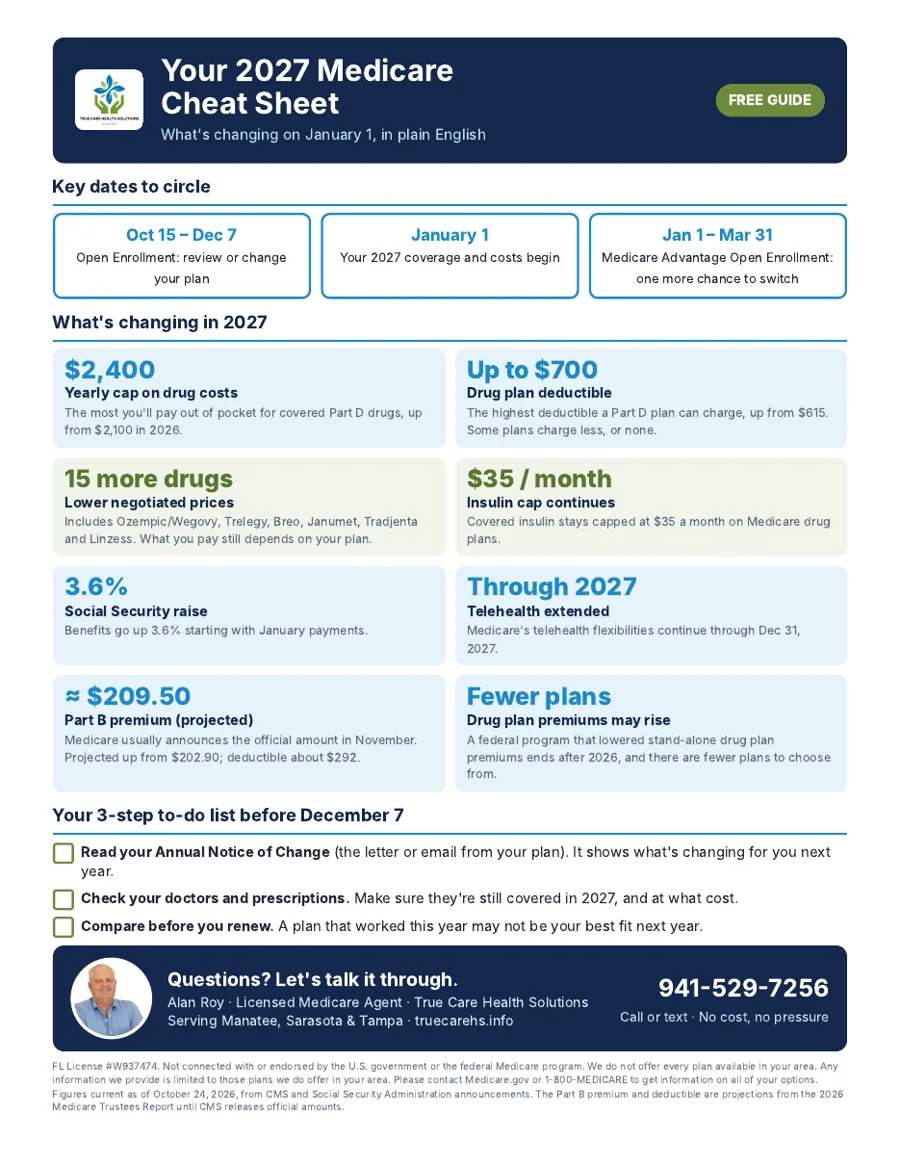
- The yearly cap on out-of-pocket costs for covered Part D drugs is $2,400 in 2027, up from $2,100 in 2026
- Plans can charge a deductible of up to $700 (some charge less, or none)
- Covered insulin stays capped at $35 a month
- More drugs have Medicare-negotiated prices. What you pay still depends on your plan.
What is the Part D late enrollment penalty?
If you go 63 days or more in a row without Part D or other creditable drug coverage after you're first eligible, you may pay a late penalty added to your premium for as long as you have Part D coverage. Signing up on time, even if you take few medications, avoids it.
Who it may fit
- You have Original Medicare (with or without a Medicare Supplement) and need drug coverage
- Your medications or pharmacy changed this year
- Your drug costs went up and you want to see if another plan costs less
- You want to avoid a late enrollment penalty
How Alan helps
- Enters your exact prescriptions and doses to compare total yearly cost, not just the premium
- Checks your preferred pharmacy and mail-order options
- Flags drugs that need prior authorization or have quantity limits
- Reviews your plan every fall when formularies change
Frequently asked questions
Do I need Part D if I don't take any medications?
It's often still worth enrolling when you're first eligible to avoid a lifelong late penalty, unless you have other creditable drug coverage, such as from a current employer.
Is there help paying for Part D?
Yes. People with limited income and resources may qualify for Extra Help from Medicare, which lowers premiums and drug costs. Alan can explain how to apply.
Can I change my Part D plan?
Yes, during Open Enrollment (October 15 – December 7) each year, and at other times if you qualify for a Special Enrollment Period, such as after a move.
Does it cost anything to work with Alan?
No. Alan's help comparing drug plans is free to you.
 Free download
Your 2027 Medicare Cheat Sheet →
This page is general educational information about Medicare and is not connected with or endorsed by the U.S. government or the federal Medicare program. Plan availability, benefits and costs vary by plan and county. We do not offer every plan available in your area. Any information we provide is limited to those plans we do offer in your area. Please contact Medicare.gov, 1-800-MEDICARE, or your local State Health Insurance Program (SHIP) to get information on all of your options.